
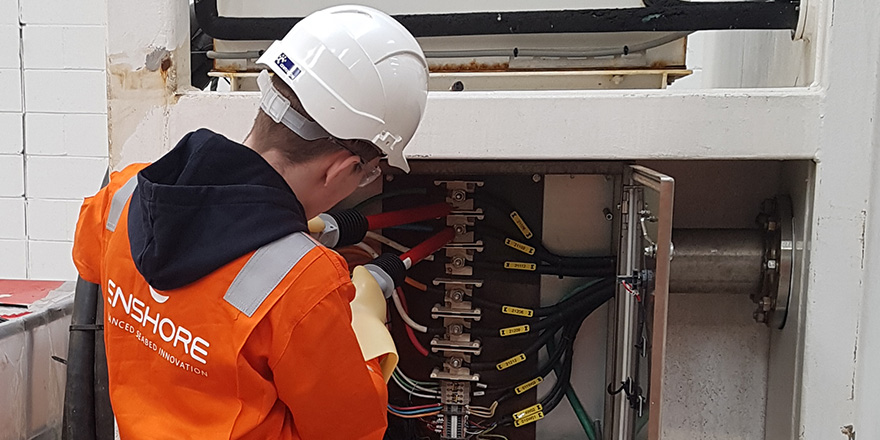
Does Training Make You Competent Offshore?
If you work offshore and have asked whether completing a training course makes you competent in your role, you are asking exactly the right question. Does training make you competent offshore? The short answer is no. Training is a vital step, but it does not make you competent on its own. Understanding the difference matters whether you are a technician working towards certification, a supervisor signing off evidence, or a manager responsible for your team’s competence scheme.
What Is the Difference Between Training and Competence?
Training provides the opportunity to build knowledge and develop some skills. It is often delivered at a training centre and tends to be generic in nature. This gives it real value as a foundation, but it is rarely enough on its own because it is not delivered in the real context where the work actually happens.
Competence can only be truly achieved in the workplace. It is demonstrated when an individual applies their knowledge and skills safely and effectively under real working conditions. A trained person knows what to do. A competent person can be observed doing it correctly, consistently, in the environment that matters.
Does Training Make You Competent Offshore? Why the Answer Is More Complex
The most common reason competence schemes fail is a lack of buy-in from management. When managers do not actively support the process, the whole system struggles. Some organisations mistakenly believe that the certification body or the candidate will handle everything independently. This is not how it works.
Competence is only achieved at the worksite. It requires the involvement of Skills Assessors, Technical Authorities, and Witnesses, as well as consistent coaching and mentoring. In offshore environments especially, the development of capable teams depends on effective leadership at every level.
What Does Good Workplace Evidence Look Like?
Good competence evidence must meet five key criteria. It should be:
- Timely: gathered at the point of performance, not retrospectively
- Relevant: directly related to the tasks being assessed
- Authentic: genuinely produced by the candidate
- Sufficient: enough evidence to confirm consistent competence
- Valid: appropriate to the standard being assessed against
The best evidence is observational. A short observation report written by a Supervisor or Assessor describing what the candidate did in a real situation is far more valuable than pages of written work. Practical situations, such as a breakdown or an ROV fault at depth, provide ideal opportunities to capture high-quality primary evidence. After the event, all that is needed is a short paragraph from the Assessor stating what the candidate did. That is perfect evidence.
What Does MTCS Look for in Real Competence?
MTCS looks for primary evidence that is valid, authentic, realistic, timely, and sufficient. A strong evidence portfolio should include at least 70 per cent observational evidence, such as MTCS competence forms and observation reports. Secondary evidence including assignments, copies of log sheets, images, and videos should support the portfolio but should not form the majority of it.
How Does Poor Planning Create Unnecessary Paperwork?
Competence schemes have a reputation for generating heavy paperwork, but this is not inevitable. A well-prepared Assessor will identify opportunities where real workplace situations produce strong evidence naturally. Good planning means deciding in advance what will be assessed, where, when, and how. This removes uncertainty and makes the whole process far more manageable for everyone involved.
What Is the Role of Supervisors and Assessors?
Supervisors and Assessors support and motivate candidates, provide coaching, and give meaningful feedback on how to achieve competence. Trained and qualified Skills Assessors are essential to keeping the process running effectively.
Companies that invest in training their supervisors to assess at the worksite see significantly better outcomes. This is where MTCS corporate training can make a real difference, equipping your people to lead the process with confidence.
Frequently Asked Questions
Can someone be competent without formal training?
Formal training is not always mandatory, but it provides the underpinning knowledge that supports competence development. Without some structured learning, candidates may struggle to meet the knowledge elements of a competence assessment. Most offshore roles require both.
Who can act as a Witness in an offshore competence assessment?
A Witness is typically a Senior PT, Supervisor, or Superintendent who has technical authority in the relevant discipline. They can sign observation evidence in the absence of a qualified Assessor. MTCS’s Competence in the Workplace course prepares personnel to act as an Approved Witness.
How long does MTCS certification last?
MTCS certificates are typically valid for three years. Renewal routes are available, and certificates can be publicly validated through the MTCS website. Visit the MTCS certification overview for full details.
Where can I learn more about competence standards offshore?
IMCA publishes widely recognised competence guidance for the marine and offshore industry. MTCS is a member company and aligns its certification standards accordingly.
Find out more about our Skills Assessor course, or visit our Support Centre for guidance on competence assessment and evidence requirements.